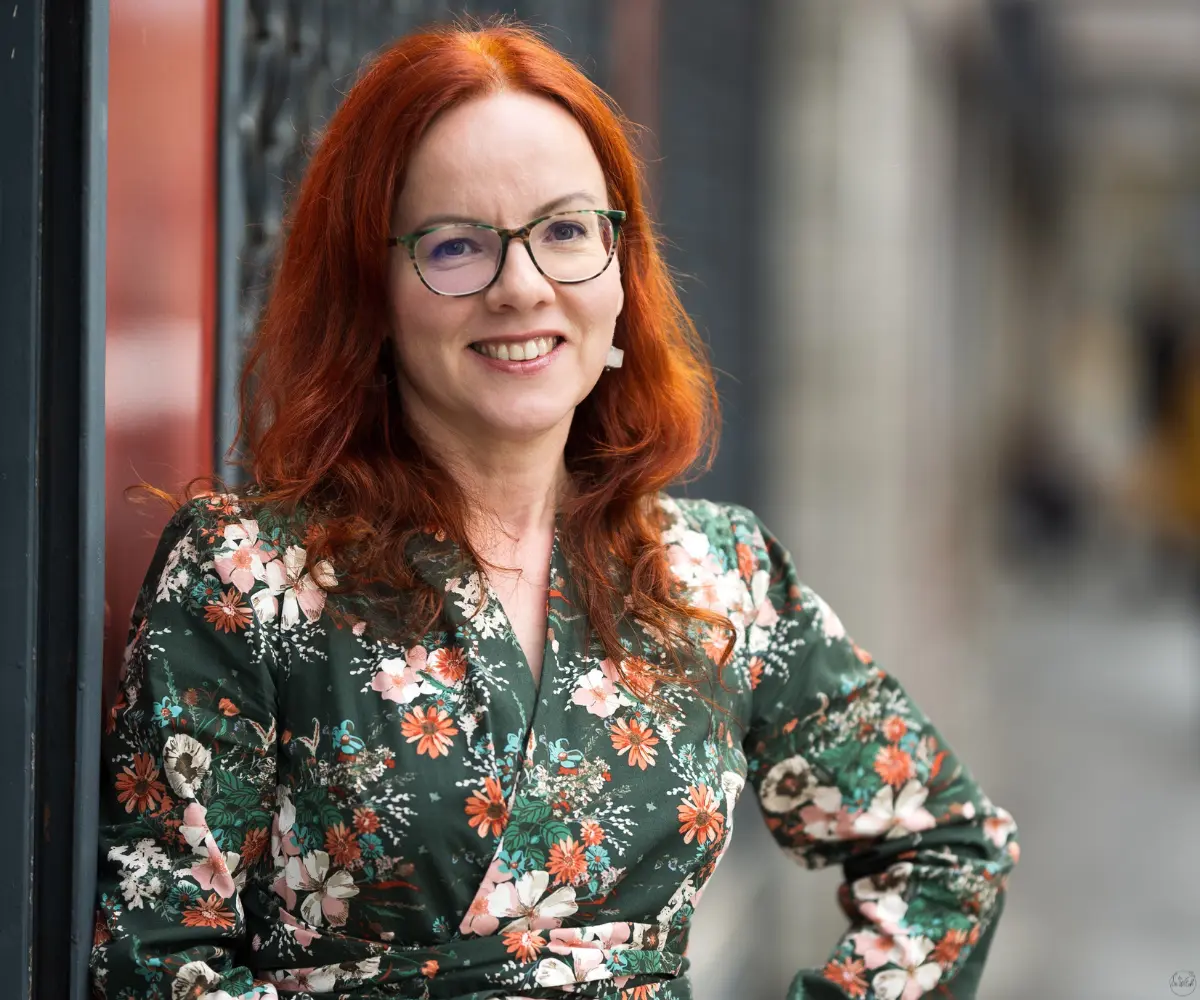

At 23, Štěpánka Živčáková experienced an unexpected onset of depression that eventually led to psychiatric hospitalisation. Today, she speaks openly about what she went through, has published a book, gives talks and works alongside mental health professionals and people with lived experience to help children and young people talk about mental health. Her story shows that even an experience that turns your life upside down can take on a new meaning over time. And that sometimes, you don’t need to have everything under control. You just need to keep going.
She is a mother of two, a wife, the author of Drátem do oka and one of the people behind Dušedílna, an organisation that visits schools with its interactive mental health programme Blázníš? No a!. Working alongside professionals and people with lived experience, the team encourages children to talk about how they are really feeling and shows them that speaking openly about mental health is neither a sign of weakness nor something to be ashamed of.
Looking back on her life today, Štěpánka can identify one experience that profoundly shaped her. At 23, she developed depression. It came unexpectedly, was difficult to put into words and became so severe that she needed psychiatric care. Yet it was there, during that time, that she first realised with absolute clarity that she didn’t want to live like this.
“I remember it very clearly. I was in a psychiatric hospital, and I knew I didn’t want to live like this. I was determined to do everything I could to accept my illness and find ways to feel better.”
Depression wasn’t something that simply disappeared one day and became a thing of the past. She learned to see it as part of her life, and gradually, as an experience she could talk about in a way that might help someone else.

When Your Own Mind Becomes an Obstacle
Mental illness can be difficult to explain to someone who has never experienced it. It can be even harder to trust your own thoughts when those very thoughts are pulling you down.
For Štěpánka, the biggest obstacle was her own mind.
“Without a doubt, my own mind. My thoughts, which we can’t always trust when we’re depressed.”
During one particularly difficult period, a doctor said something that stayed with her: “Your thoughts are not you.” At the time, she didn’t fully understand what it meant. Today, she sees it differently.
Learning to separate who she is from what is happening in her mind marked an important turning point. Depression became part of her story, but it didn’t define her entire identity. That doesn’t mean she wishes it had never happened. On the contrary, she has learned to accept it as something that is part of who she is.
“Let’s be honest, none of us wants to experience mental illness. It’s difficult to understand and even harder to put into words. Still, I see it as something that’s part of me, not something that should stop us from enjoying life.”
And it was this acceptance that eventually grew into something reaching far beyond her own experience.
When Your Own Experience Starts Helping Others
After experiencing depression, Štěpánka began talking openly about it. She published her book Drátem do oka and started giving talks about depression. Over time, however, she realised that simply raising awareness wasn’t enough.
“I realised that while it was great to talk about depression and bring the subject into the open, something important was missing: what do you do when depression is affecting someone right now? How can we help ourselves, and most importantly, how can we prevent depression?”
That was how Dušedílna came about, an organisation she co-founded with a friend and colleague. Its aim is to talk about mental health before it becomes a subject people would rather avoid.
Together with a team of professionals and people with lived experience, whom they call peers, she visits schools with the programme Blázníš? No a! Rather than a traditional lecture where children sit quietly and listen to theory, the programme is interactive and starts with what the pupils themselves are experiencing.
Each day, the team checks in with them, asking how they feel, how they take care of their mental health and what helps them through difficult moments. The programme also guides them towards professional support available in their local area.
The central idea is simple.
“Mental health shouldn’t be taboo.”
Štěpánka wants us to feel no shame about seeing a psychologist. She believes looking after our minds should be no different from looking after our bodies.
“I personally believe that just as we all have a GP, it’s perfectly normal to have a psychologist, therapist or coach, too. Looking after our mental health is just as important as looking after our physical health.”

Some Things Aren’t Meant to Be Done Alone
Dušedílna didn’t begin as a fully formed project with a clear plan. Instead, Štěpánka had been carrying the idea around for a long time, waiting to find the right people to bring it to life.
“It was definitely something I’d been thinking about for a long time. I just hadn’t found the right people to do it with. Or, in my case, I realised I didn’t want to do it alone anymore.”
Working together is now one of the key principles behind everything she does. She can accomplish a great deal on her own, but joining forces with others allows their work to have a much greater impact.
Taking the first step wasn’t easy, though. Leaving her job as a peer worker meant not only deciding to pursue something new but also dealing with all the practicalities that came with it: setting up an organisation, managing the accounts and handling the paperwork. And administration is something she really can’t stand.
“I absolutely hate those things, but they have to be done.”
Today, she knows that even the tasks we dislike don’t necessarily mean we’re on the wrong path. Sometimes, they’re simply part of building something we believe in.
Dušedílna has also shown her just how many people are willing to lend a hand.
“The incredible support from the people around me made me realise just how many wonderful people there are in this world.”
Against the backdrop of depression, that can be a particularly important realisation. When you’re trapped inside your own thoughts and the world seems hopeless, it isn’t always easy to see the people standing beside you. Today, Štěpánka sees them clearly.
When Results Take Time to Show
Any project that aims to make a difference brings moments of doubt, when you start wondering whether what you’re doing really matters. Štěpánka has had her share of those moments, too.
“Oh my goodness. There have been plenty, and I’m sure there will be more.”
In her case, though, it often takes just one tangible reminder that the work matters: feedback from pupils who have taken part in the programme. One particular comment has stayed with her. A pupil wrote that it had been the best morning of their entire nine years at school.
Reactions like that are now among her greatest achievements. It’s not about the number of activities or how impressive the project looks from the outside. What matters is the moment you realise you’ve genuinely reached someone.
Sometimes, there’s another sign. At the end of public events organised by Dušedílna, participants ask whether there will be another one. For Štěpánka, that’s confirmation that it’s worth carrying on.
Her dream for the organisation now is to create a dedicated space of its own, somewhere the team could meet and where therapy sessions and meetings with specialists could also take place.

You Don’t Have to Be Perfect to Keep Going
Štěpánka knows she tends to want things to be perfect. Absolutely flawless. But life and work, she has learned, don’t operate that way.
“I’d love everything to be perfect, absolutely flawless. But that’s just not possible. So I remind myself that something imperfect is better than nothing, and every little step counts.”
She approaches fear in much the same way.
She describes it as something like her second-best friend. It hasn’t gone away. She’s simply learned to deal with it differently.
One phrase helps her: “Fear, welcome.”
Rather than running away from fear, she tries to recognise it, acknowledge it and consider the worst that could happen. At the same time, she allows herself to imagine the opposite: how well things might turn out. She also works through her fears in therapy. She doesn’t feel the need to pretend she can handle everything on her own. When she’s struggling, she tries to call things what they are.
“When I feel awful, I feel awful. But things will get better.”
What helps is her “pack”, the people around her, along with nature, time alone and moments spent in good company. Sometimes she needs to go offline. At other times, she reads, writes or focuses on her breathing.
It’s not a perfect formula for life. It’s more about learning to recognise what you need in any given moment.
Success Doesn’t Have to Look Perfect
When Štěpánka was younger, she would probably have defined success differently from the way she does today. Her current idea has much less to do with what other people can see.
“For me, success means doing what we enjoy and what feels meaningful. It also means being surrounded by people who inspire us and support us.”
Like so many things in life, she doesn’t consider her definition of success fixed, either.
“I live by the idea that the only certainty is that everything changes.”
When things are going well, humour and a sense of lightness are essential to her. And perhaps that’s an important thing to remember when reading a story that begins with depression and psychiatric hospitalisation.
Her life today isn’t all about mental health, therapy and difficult conversations. There’s her family, including a husband she considers her anchor. There are her two children, the people she works with, the pupils she visits at school, her book and her projects. There’s also the simple pleasure of everyday life, like when a driver stops to let her cross the road.
“I wave to say thank you, and they smile back. I love that.”
And when there’s nothing to prove and nowhere she needs to rush off to, her ideal day is surprisingly simple. Everyone is at home, together. It doesn’t really matter what they’re doing.
What If Things Don’t Go to Plan?
Štěpánka knows that some periods of life will be easier than others. When she feels that nothing is going the way she’d hoped, she reminds herself that this is just one part of the bigger picture.
“I tell myself that this is just a phase. And every phase eventually passes.”
Perhaps this ability to see the present as temporary helps her keep going when doubts creep in.
She hasn’t got rid of them, any more than she’s got rid of fear. The difference is that she no longer has to wait for them to disappear before she can take action.
She can feel afraid and still carry on. Doubts may arise, yet she can take the next step. Even when things aren’t perfect, her actions can make a difference.
If she could go back and talk to her younger self, she’d tell her that challenges are there to be overcome, and that she would get through them.
She also wouldn’t change her decision to self-publish her book. Although she’d approach its sales and promotion differently today, she would make the same decision all over again. Some paths don’t have to be perfect to be right. And some experiences don’t have to be pleasant to lead us somewhere we need to be.
Štěpánka’s life today isn’t a story about having everything figured out. She describes it more as a roller coaster.
“It’s a pretty wild roller-coaster ride sometimes. I scream, I cry now and then, but I’m still on it.”
Perhaps that’s where the strength of her story lies. Not in never falling, never being afraid or always knowing what comes next, but in carrying on despite it all.
It means speaking openly when things get difficult, reaching out for help, making peace with the fact that not everything will go as planned, and choosing to surround yourself with people who will support you. And in taking one more small step.
Because, as Štěpánka herself says:
“Nothing is impossible.”
Bc. Štěpánka Živčáková is the author of Drátem do oka, a book about depression, a facilitator of primarily preventive programmes, a peer worker and co-founder of Dušedílna.